
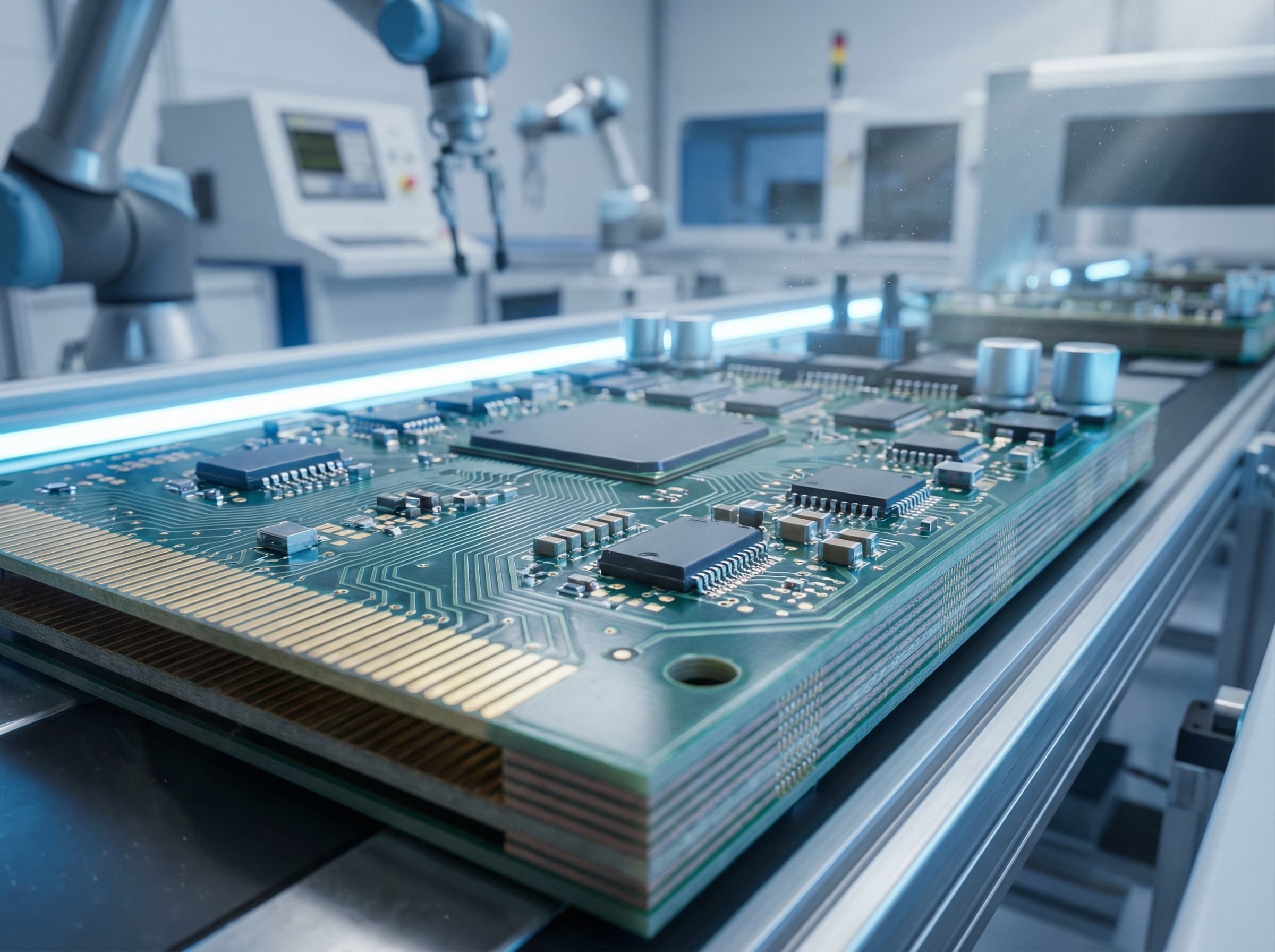
10-12 layer PCBs represent the high end of standard multilayer production, serving semiconductor test equipment, telecommunications infrastructure, and advanced computing platforms where signal layer count, power plane allocation, and routing density exceed what 8-layer boards can deliver. XinAn PCB fabricates 10 and 12-layer boards using FR-4 substrates with Tg 170°C to Tg 250°C, incorporating sequential lamination, laser microvias, and back-drilling as standard process options. These boards support BGA devices with 2000+ pins at 0.4mm pitch, DDR5 memory channels at 4800MT/s, and PCIe Gen5 interfaces at 32GT/s. Our registration accuracy of ±2mil across all layers and impedance tolerance of ±7% enable reliable high-speed digital designs at the limits of FR-4 material capability.

XinAn PCB
10-12 Layer PCB
Maximum Complexity
Maximum Complexity
10-12 Layer PCB
Our highest layer-count capability, 10-12 layer PCBs for the most demanding designs. Suitable for semiconductor, telecom infrastructure, and automotive ADAS systems.
Layers
10 - 12
Material
FR-4 (TG170 - TG250)
Thickness
1.0 - 4.0mm
Copper Weight
0.5 - 3oz
Max Size
500 × 600mm
Min Trace/Space
3/3 mil
Min Drill
0.15mm
Impedance Control
±10%
Blind/Buried Via
Yes
Surface Finish
HASL, Lead-free HASL, ENIG, Immersion Silver
Solder Mask
green, black
Silkscreen
white
Technical Specifications
10-12 layer stackups require careful balancing of signal routing layers, reference planes, and power distribution planes within a target finished thickness—typically 1.6-2.4mm. A standard 12-layer arrangement might use signal/ground/signal/ground/signal/power/ground/signal/ground/signal/ground/signal, providing six signal routing layers with every signal layer adjacent to a reference plane. We optimize prepreg and core thicknesses to achieve target impedances while maintaining symmetric stackups to prevent warpage—a critical concern for boards destined for BGA assembly with reflow temperatures exceeding 245°C. The coefficient of thermal expansion (CTE) mismatch between thick copper planes and thin dielectric layers creates internal stress during lamination, which we manage through controlled cool-down rates of 2-3°C/minute in the lamination press. For 12-layer boards exceeding 2.0mm thickness, we specify multiple prepreg sheets between layers to ensure adequate resin fill without voids.
At 10-12 layers, via management becomes a primary design and fabrication challenge. A typical 12-layer HDI design may incorporate three types of vias: through-holes connecting all layers, blind microvias connecting L1-L2 or L11-L12, and buried vias connecting inner layer pairs. Our sequential build process handles up to 3 lamination cycles for complex via structures, with X-ray registration verification at each stage. Stacked microvia reliability is ensured through copper-filled via plating with a fill ratio exceeding 90% and a dimple depth below 15μm, meeting IPC-4761 Type VII requirements. For 10-12 layer boards with through-holes, back-drilling stub lengths to within 8mil (200μm) of the target layer eliminates via stub resonance that would otherwise degrade 10G+ signal channels. The back-drill depth accuracy of ±4mil ensures the drill reaches the stub without damaging the target signal layer.
Semiconductor ATE (Automatic Test Equipment) load boards represent a major application for 10-12 layer PCBs, where hundreds of high-speed test channels must route from DUT (Device Under Test) socket pins to tester interface connectors with matched trace lengths within ±1mil. Telecom infrastructure—5G baseband units, optical line terminal (OLT) cards, and backbone router line cards—uses 10-12 layer boards for ASIC and network processor carrier sections handling aggregate bandwidth exceeding 100Gbps. High-performance computing platforms including GPU carrier boards and server CPU interposers require 12-layer constructions to distribute 8-12 power rails with milliohm-level PDN impedance while maintaining signal integrity on thousands of nets. Data storage controllers for NVMe SSD arrays and enterprise RAID systems also rely on 10-12 layer PCBs.
Our 10-12 layer production quality system enforces hold points at each inner layer imaging stage, each lamination cycle, and after final drilling. Inner layers are electrically tested for continuity and isolation before lamination—catching defects before they become buried in the finished board. Registration is verified by X-ray measurement of drill-to-pad offset on all layer pairs, with statistical process control (SPC) charts maintained in real time. First article boards undergo comprehensive microsection analysis at 12+ locations sampling every via type and every layer transition. High-reliability builds include CAF (Conductive Anodic Filament) resistance testing per IPC-TM-650 2.6.25 to verify dielectric integrity under voltage bias and humidity stress. We provide complete data packages including impedance test reports, cross-section photographs, microsection measurements, and dimensional inspection data traceable to NIST-calibrated instruments.
Get Your PCB Quote
Upload your Gerber file | we reply within 24 hours.