
Double-side aluminum PCBs extend the thermal management advantages of single-layer IMS technology to designs requiring components or traces on both sides of the board. XinAn PCB manufactures 2-layer aluminum-core boards with thermal dielectric on both faces of the aluminum base, enabling circuit routing on top and bottom surfaces with the aluminum core serving as both a heat spreader and a structural backbone. This construction addresses applications where single-side routing density is insufficient but the thermal performance of an aluminum substrate is still required—situations that conventional FR-4 double-layer boards cannot satisfy. Through-hole interconnection between the two circuit layers passes through insulated vias that penetrate the aluminum core without electrical contact to the metal.

XinAn PCB
Double-Side Aluminum PCB
Dual-Layer IMS Board
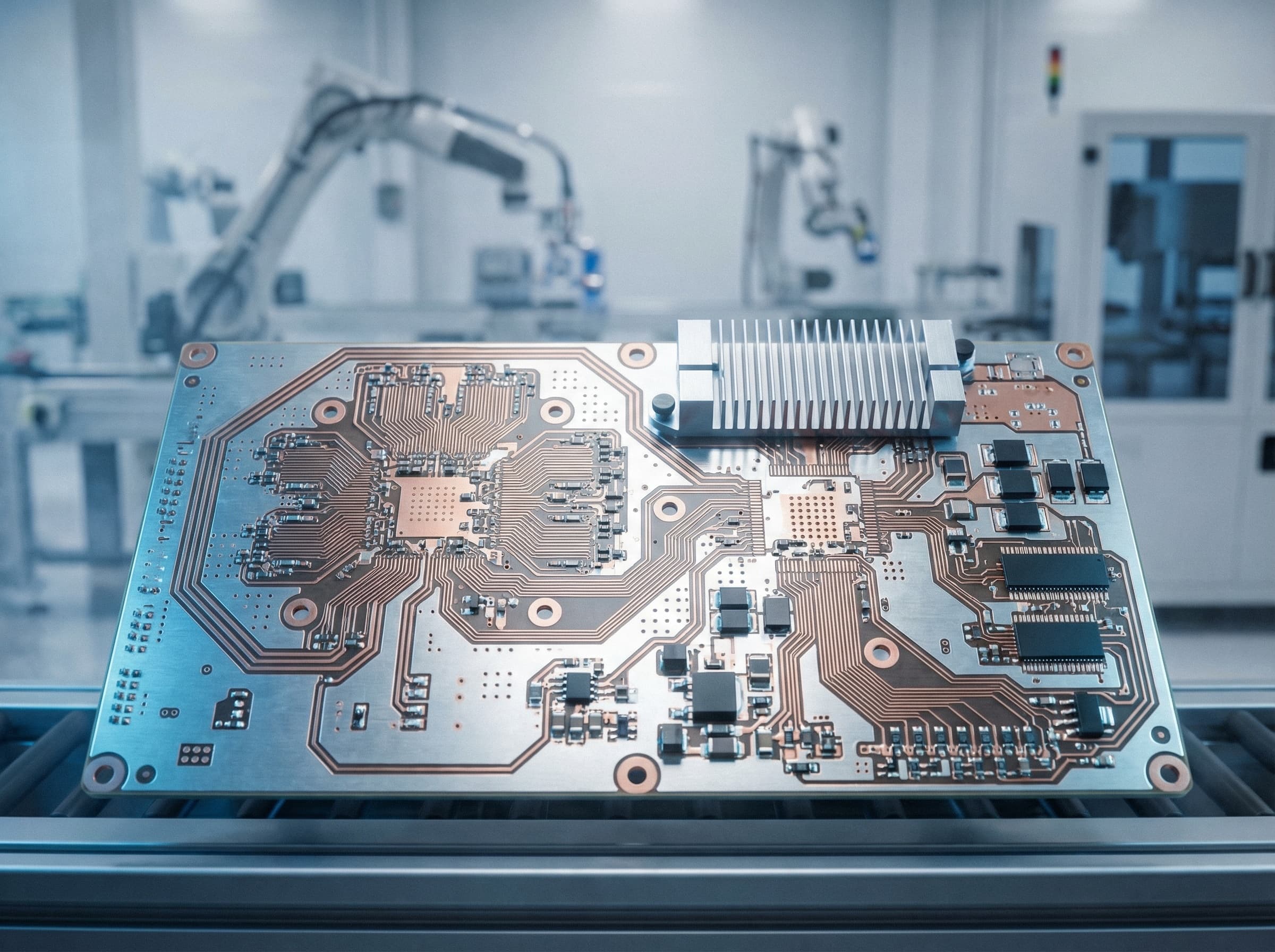
Dual-Layer IMS Board
Double-Side Aluminum PCB
Double-sided aluminum PCBs for more complex LED and power circuits requiring components on both sides with excellent thermal management.
Layers
2
Material
Aluminum 1060/5052/6061
Thickness
0.8 - 3.0mm
Copper Weight
1 - 4oz
Max Size
500 × 600mm
Min Trace/Space
4/4 mil
Min Drill
0.3mm
Thermal Conductivity
1.0 - 10.0 W/m·K
Surface Finish
HASL, Lead-free HASL, ENIG
Solder Mask
white, black
Silkscreen
black, white
Technical Specifications
The double-side aluminum PCB stackup consists of five layers: top copper circuit, top dielectric, aluminum core, bottom dielectric, and bottom copper circuit. The aluminum core thickness ranges from 0.8mm to 3.0mm, with dielectric layers of 75-150μm on each side. The principal manufacturing challenge lies in creating electrically isolated vias through the conductive aluminum core. Our process drills through the entire stackup, then reams the hole in the aluminum layer to a larger diameter (typically 0.5-0.8mm larger than the finished via), fills the reamed portion with insulating epoxy, and then plates the via barrel with copper to form the top-to-bottom interconnect. This insulated via process limits minimum via pitch to 1.5mm and minimum via diameter to 0.5mm—substantially larger than standard FR-4 through-holes. Designers must plan component placement and routing around these via constraints.
The thermal performance of double-side aluminum PCBs is governed by the same dielectric thermal conductivity parameters as single-side versions, but with the added complexity of heat sources on both board faces. The aluminum core still functions as an efficient heat spreader, distributing thermal energy laterally to the edges or to mounting points. However, the presence of dielectric on both sides means that heat from one side must pass through one dielectric layer plus the aluminum core to reach a heatsink mounted on the opposite side. For this reason, we recommend placing the highest-power components on the side closest to the heatsink and using thermal vias—large-diameter plated vias filled with thermally conductive paste—to create direct thermal paths through the stackup. With 2.0 W/m·K dielectric and a 1.0mm aluminum core, the through-board thermal resistance is approximately 1.5°C/W per cm², which is still 3-5× better than double-layer FR-4.
Double-side aluminum PCBs fill the niche between single-side aluminum boards (limited routing) and standard FR-4 double-layers (limited thermal performance). Power LED modules requiring driver circuitry co-located with the LED array benefit from placing LEDs on one side and the switching converter on the other, sharing the common thermal core. Motor controller boards for brushless DC motors can mount the power MOSFETs on one side and the gate driver and microcontroller on the other. Audio amplifier boards—particularly Class D designs with significant power dissipation—use double-side aluminum construction for combined thermal management and compact layout. The primary trade-off is via density: with minimum via pitch of 1.5mm, double-side aluminum boards are not suitable for fine-pitch BGA devices. Designs should favor leaded packages (QFP, SOIC) and through-hole power components.
Double-side aluminum PCB inspection adds via insulation integrity verification to the standard aluminum PCB test suite. Each insulated via is tested for isolation resistance to the aluminum core, with a minimum acceptance threshold of 100MΩ at 500V DC. Cross-section analysis of insulated vias verifies epoxy fill integrity, reaming concentricity, and copper barrel plating thickness. The copper-to-aluminum clearance in the via must be a minimum of 0.2mm radially to prevent dielectric breakdown under operating voltage and thermal stress. Thermal cycling from -40°C to +125°C for 300 cycles verifies that the differential CTE between the epoxy via fill and the aluminum core does not cause cracking or delamination. Electrical continuity and isolation testing follows IPC-9252 protocols on 100% of production boards.
Get Your PCB Quote
Upload your Gerber file | we reply within 24 hours.