

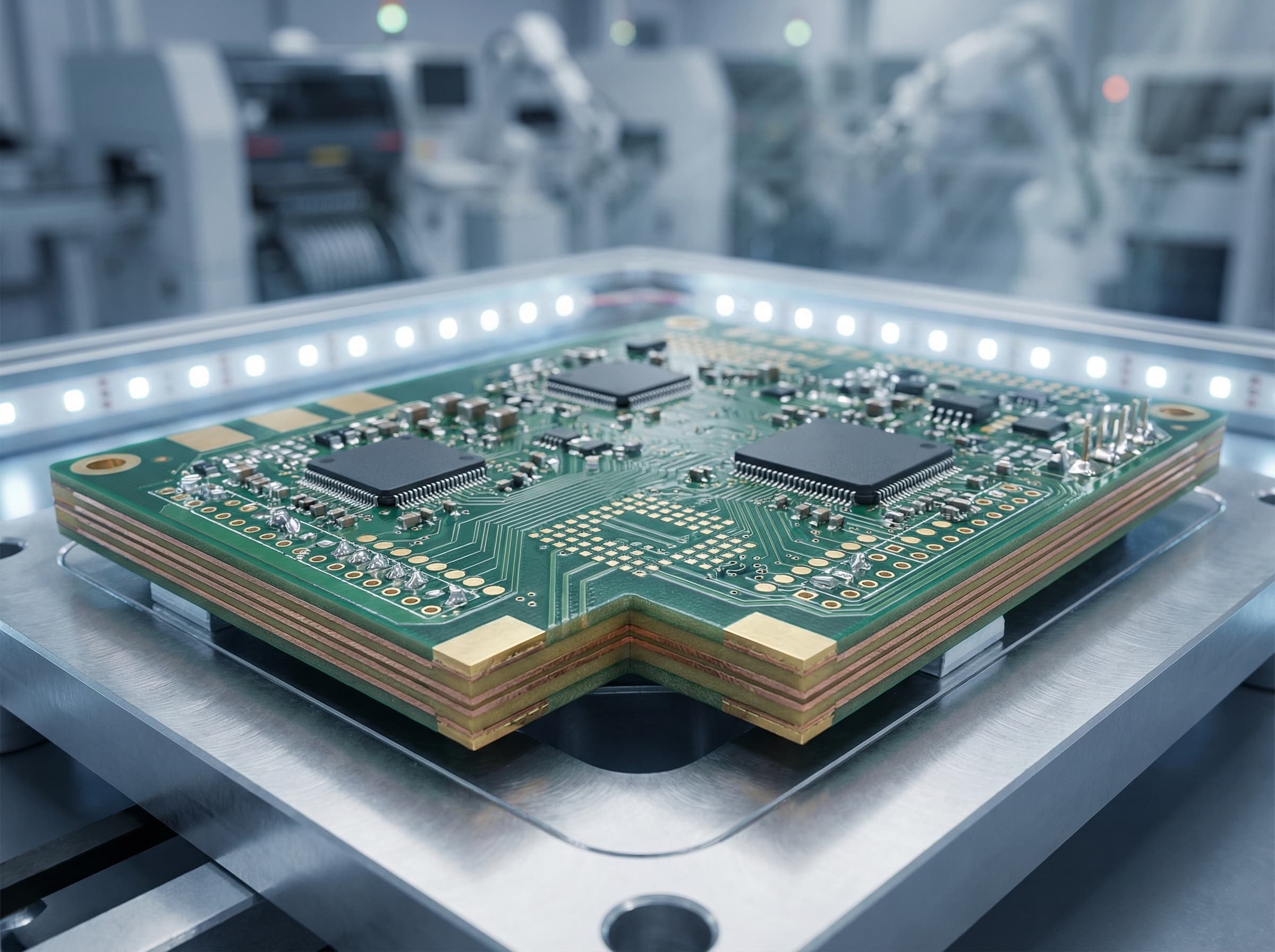
The 4-layer PCB stackup is the entry point into multilayer technology, and it remains the most widely produced multilayer construction in the industry. XinAn PCB manufactures 4-layer boards using FR-4 substrates with glass transition temperatures from Tg 135°C to Tg 250°C, supporting controlled impedance designs, blind and buried vias, and fine-pitch BGA routing. The standard 4-layer stackup—signal/ground/power/signal—provides a continuous reference plane for impedance-controlled traces, effective EMI shielding, and sufficient routing density for microcontrollers, FPGAs, and wireless modules with up to 300-400 pins. Our 4-layer process achieves ±8% impedance tolerance on controlled lines and ±2mil registration accuracy between layers.
Stackup Design and Impedance Control
The most common 4-layer stackup places signal layers on the outer surfaces (L1, L4) with ground and power planes on the inner layers (L2, L3). This arrangement provides adjacent reference planes for both signal layers, enabling 50Ω single-ended and 100Ω differential impedance control for digital interfaces including USB 2.0, LVDS, and RGMII. We calculate impedance using field-solver software calibrated against TDR measurements on production test coupons, accounting for actual measured Dk values, resin content, and copper roughness (Rz). For high-Tg applications (Tg 170°C+), Dk values shift slightly higher (4.4-4.8 at 1GHz), which must be factored into impedance calculations. Standard dielectric thickness between L1-L2 and L3-L4 ranges from 4mil to 12mil depending on impedance targets, while the core between L2-L3 is typically 40-47mil for a finished board thickness of 1.6mm.
Blind and Buried Via Technology
XinAn PCB offers blind vias (L1-L2 or L3-L4) and buried vias (L2-L3) on 4-layer constructions for designs requiring higher routing density without increasing layer count. Blind vias are formed by controlled-depth drilling from the outer surface to the first inner layer, with depth accuracy of ±2mil using laser depth sensing on our CNC drill platforms. Buried vias between L2 and L3 are drilled and plated on the core laminate before outer layer lamination. The sequential lamination process adds approximately 2-3 working days to the standard lead time and requires additional registration controls to maintain layer-to-layer alignment. Minimum blind via diameter is 0.15mm (6mil) for mechanical drilling and 0.1mm (4mil) for laser drilling. Designers should note that blind/buried vias increase fabrication cost by 30-50% compared to standard through-hole-only constructions.
Applications and Performance Envelope
4-layer PCBs serve the mainstream of electronic product design. IoT gateway modules, Wi-Fi routers, and Bluetooth audio devices commonly use 4-layer boards to achieve the routing density and ground plane integrity required for RF performance. Industrial control systems—PLCs, HMI displays, and motor drive interfaces—use 4-layer stackups for noise immunity in electrically harsh environments. Automotive body electronics modules, instrument clusters, and infotainment systems frequently specify 4-layer boards with high-Tg (170°C+) materials to meet AEC-Q100 temperature grade requirements. The 4-layer construction supports clock frequencies up to 200-300MHz with proper design practices, adequate for ARM Cortex-M/A series processors, DDR3 memory interfaces, and Gigabit Ethernet PHYs.
Quality Verification and Deliverables
Our 4-layer boards undergo inner layer AOI before lamination, verifying trace geometry and plane integrity while rework is still possible. Post-lamination, X-ray inspection confirms via registration to inner layer pads, with acceptance criteria of ≤3mil offset per IPC-6012. Impedance testing on dedicated test coupons uses TDR measurement with results reported on the impedance test certificate shipped with each lot. Electrical testing—flying probe or fixture-based—verifies all nets for continuity and isolation. Cross-section microsectioning on first articles validates plating thickness (≥20μm barrel, ≥25μm surface), dielectric spacing, and inner layer registration. We supply boards with full IPC-6012 Class 2 documentation as standard, with Class 3 available for high-reliability applications.