
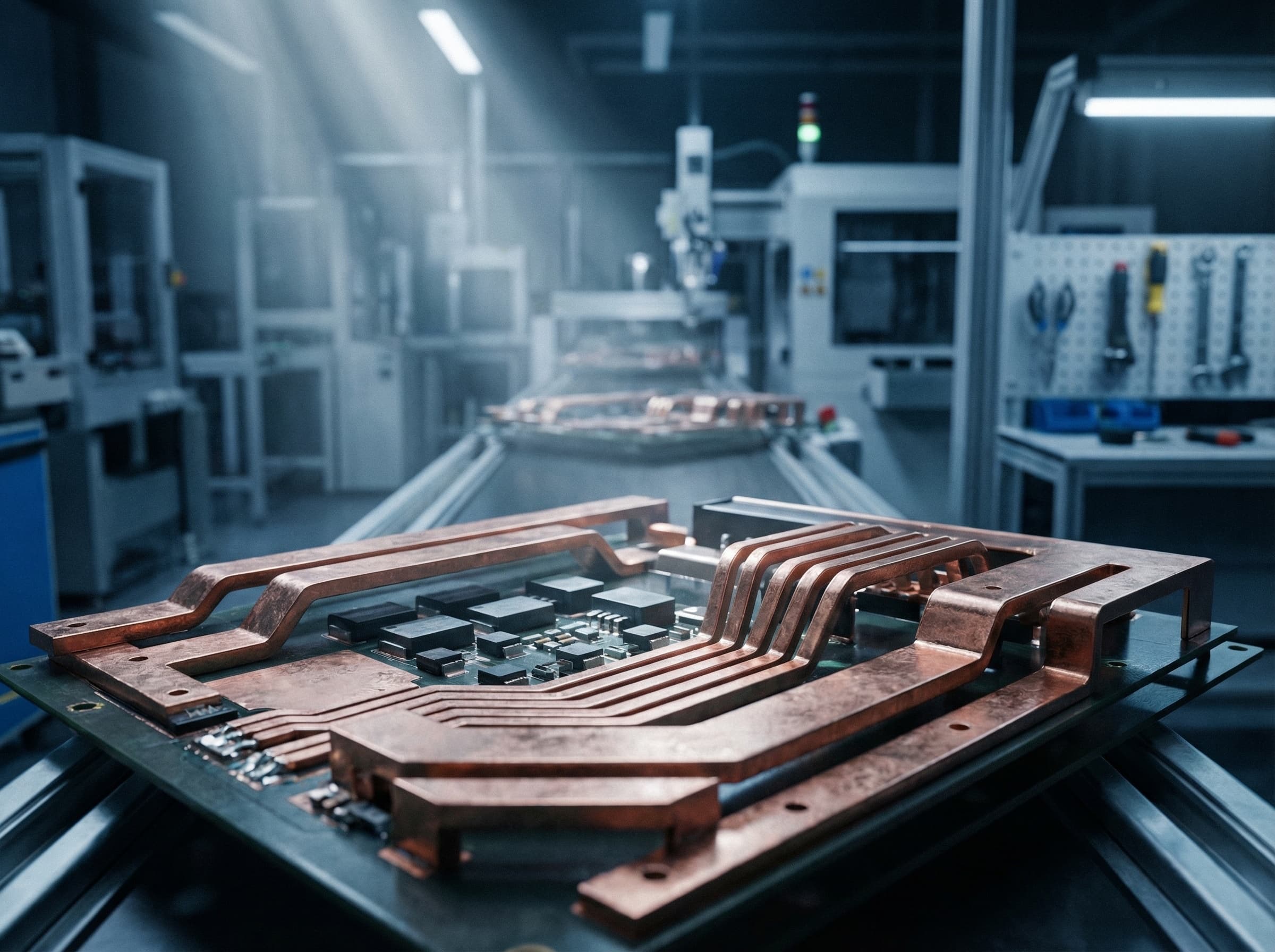
Heavy copper PCBs—defined as boards carrying 3oz/ft² or greater copper weight on one or more layers—are engineered for high-current, high-thermal-demand applications that standard 1-2oz boards simply cannot serve. XinAn PCB manufactures heavy copper boards from 1 to 8 layers using FR-4 substrates, with copper weights ranging from 3oz up to 10oz per layer. These boards handle sustained currents exceeding 100A on a single trace, dissipate significant thermal loads through copper plane conduction, and withstand the thermal cycling stresses inherent in power electronics. Our heavy copper process incorporates specialized etching profiles, extended plating cycles, and modified lamination parameters to deliver reliable high-current interconnects within controlled geometric tolerances.

XinAn PCB
Heavy Copper PCB
High Current Capacity
High Current Capacity
Heavy Copper PCB
Heavy copper PCBs with 3-10oz copper weight for high-current applications. Excellent thermal management and power handling for automotive and industrial power electronics.
Layers
1 - 8
Material
FR-4
Thickness
0.8 - 4.0mm
Copper Weight
3 - 10oz
Max Size
650 × 2000mm
Min Trace/Space
4/4 mil
Min Drill
0.2mm
Surface Finish
HASL, Lead-free HASL, ENIG, OSP
Solder Mask
green, black
Silkscreen
white
Technical Specifications
Heavy copper fabrication diverges from standard PCB processing at nearly every step. Etching 6oz or 10oz copper requires significantly longer spray etch times and adjusted conveyor speeds, which naturally produces trapezoidal trace cross-sections. At 6oz copper, the lateral etch undercut typically equals the copper thickness, meaning a nominal 20mil trace on artwork produces approximately 8mil at the top surface. We compensate for this with etch factor calculations applied during CAM processing, adding copper width to artwork features based on measured etch rates per copper weight. Through-hole plating for heavy copper designs requires extended plating cycles—up to 4 hours for 10oz boards—to deposit the 50-75μm barrel copper needed to survive thermal stress testing. Lamination uses controlled ramp-rate press cycles with extended dwell times to ensure full resin flow around thick copper features and prevent voiding.
The primary advantage of heavy copper is current-carrying capacity and thermal conduction. A 200mil-wide trace at 6oz copper thickness carries approximately 40A with a 20°C temperature rise in free air, compared to only 8A for the same width at 1oz. For busbars and power distribution planes, 10oz copper provides thermal conductivity equivalent to a 350μm-thick copper sheet integrated directly into the PCB stackup. Designers should account for the thicker copper when specifying dielectric spacing—minimum prepreg thickness between a 6oz layer and an adjacent signal layer should be at least 8mil to maintain adequate voltage isolation. Via current capacity scales with barrel plating thickness; a 20mil drilled via with 2mil barrel plating safely carries 8-10A continuous. We recommend via arrays or slotted vias for currents exceeding 15A per interconnect point.
Heavy copper PCBs serve power electronics applications across energy, transportation, and industrial sectors. Solar inverters and wind turbine converters use 4-6oz copper for DC bus distribution and IGBT gate drive circuits. Electric vehicle onboard chargers and DC-DC converters require 6-10oz copper layers to manage 200-800V bus voltages at 50-200A operating currents. Industrial motor drives, welding equipment controllers, and UPS systems are further volume applications. Military and aerospace power supplies specify heavy copper for its superior thermal shock resistance compared to busbar-on-board alternatives. We also supply heavy copper boards for battery management systems (BMS) where high-current sense traces and power distribution traces coexist with low-current signal circuitry on the same multilayer stackup.
Heavy copper boards undergo enhanced quality protocols beyond standard IPC-6012 requirements. Cross-section analysis verifies copper thickness at minimum, typical, and maximum trace locations across the panel, with acceptance criteria of ±10% on finished copper weight. Thermal stress testing per IPC-TM-650 2.6.8 subjects coupons to 6 cycles of 288°C solder float for 10 seconds each, followed by microsection examination for barrel cracking, pad lifting, or delamination. High-current boards receive hipot testing at 500-2500V DC per the design's working voltage class. Dimensional inspection validates that etch compensation has achieved the target trace widths within ±2mil tolerance on finished features. All heavy copper production carries full IPC-6012 Class 3 traceability when specified.
Get Your PCB Quote
Upload your Gerber file | we reply within 24 hours.