
Copper base PCBs represent the pinnacle of metal-core thermal management, leveraging the inherent thermal conductivity of copper—380 W/m·K for C1100 alloy and 390 W/m·K for C1020 oxygen-free grade—to achieve thermal spreading performance that aluminum substrates cannot match. XinAn PCB manufactures copper base boards using C1100 (electrolytic tough pitch) and C1020 (oxygen-free high conductivity) copper alloys as the structural core, with thermally conductive dielectric layers bonding the circuit copper to the base. Where aluminum IMS boards achieve adequate thermal management for most LED and power applications, copper base PCBs serve the extreme thermal demands of high-power laser drivers, concentrated photovoltaic cells, high-frequency RF power amplifiers, and IGBT module substrates where every degree of temperature reduction extends component lifetime and improves performance.

XinAn PCB
Copper Base PCB
Ultimate Heat Dissipation
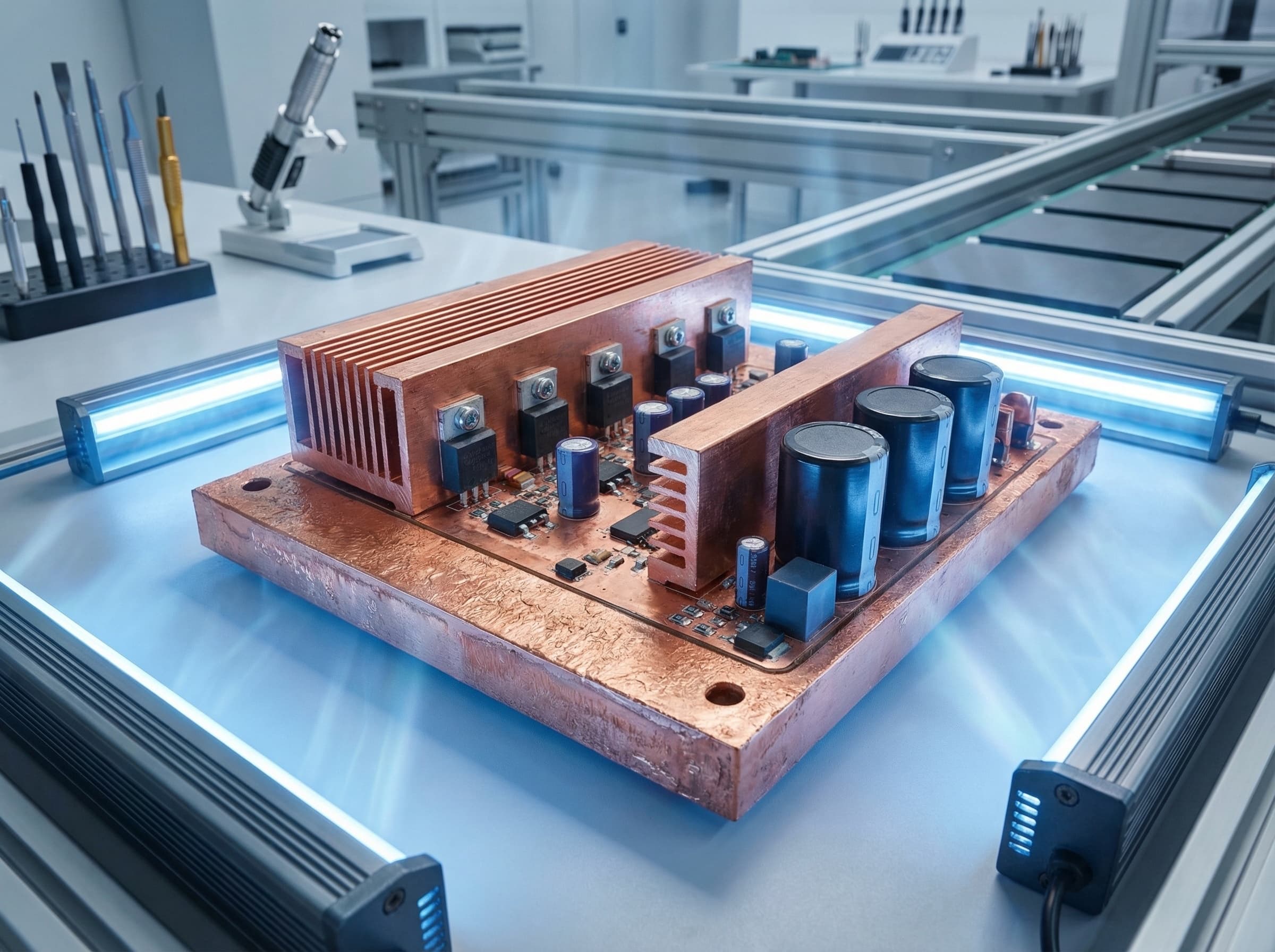
Ultimate Heat Dissipation
Copper Base PCB
Copper base PCBs with 380 W/m·K thermal conductivity — the ultimate solution for extreme thermal management in high-power LED, automotive ECU, and power module applications.
Layers
1 - 2
Material
Copper C1100/C1020
Thickness
0.8 - 3.0mm
Copper Weight
1 - 6oz
Max Size
500 × 600mm
Min Trace/Space
4/4 mil
Min Drill
0.3mm
Thermal Conductivity
380 W/m·K (base)
Surface Finish
HASL, Lead-free HASL, ENIG, OSP
Solder Mask
green, black
Silkscreen
white
Technical Specifications
Copper base PCB construction mirrors aluminum IMS architecture: a circuit copper layer bonded through a thermally conductive dielectric to a copper alloy base plate. However, the copper base provides nearly double the thermal conductivity of aluminum (380 vs. 200 W/m·K), resulting in significantly better lateral heat spreading from point-source heat loads. The C1100 alloy (99.9% Cu, ≤0.04% O) is the standard choice offering excellent thermal conductivity at a moderate cost premium over aluminum. C1020 oxygen-free copper (99.96% Cu, ≤10ppm O) is specified for applications requiring vacuum brazing compatibility or where oxygen content affects reliability—such as hermetically sealed military and space electronics. Base plate thickness ranges from 0.8mm to 5.0mm, with 1.0-2.0mm being most common. The dielectric layer typically uses the same ceramic-filled systems as high-thermal aluminum boards, with conductivity ratings from 2.0 to 10.0 W/m·K. The overall thermal path from circuit surface to base plate bottom achieves thermal resistance values of 0.1-0.5°C/W depending on dielectric grade and thickness.
Copper base PCB fabrication presents unique processing challenges compared to aluminum core boards. Copper's higher hardness and ductility require modified CNC routing parameters—slower feed rates, sharper tooling, and coolant application—to achieve clean edge profiles without burring. The density of copper (8.96 g/cm³ vs. aluminum's 2.70 g/cm³) makes panels over 300×400mm unwieldy in standard conveyorized processing equipment, so panel sizes are typically limited to 300×500mm maximum. Copper's coefficient of thermal expansion (17 ppm/°C) is closer to FR-4 (14-17 ppm/°C) than aluminum's CTE (23 ppm/°C), which actually improves reliability at the dielectric interface under thermal cycling. However, copper oxidizes readily during thermal processes, so lamination and any subsequent heating steps require nitrogen inerting or anti-oxidation surface treatments. Cost is the primary trade-off: copper base material is 3-5× the cost of equivalent aluminum substrate, which limits adoption to applications where thermal performance justifies the investment.
Copper base PCBs serve applications where thermal failure is catastrophic or where millidegree temperature differences affect system performance. High-power laser diode submounts use copper base PCBs to extract 50-100W of waste heat from laser bars operating at >60% wall-plug efficiency, where junction temperature directly determines wavelength stability and lifetime. Concentrated photovoltaic (CPV) receiver boards mount multi-junction solar cells operating at 500-1000× solar concentration, generating heat flux densities exceeding 50W/cm². RF power amplifier pallets for UHF/L-band radar transmitters use copper base PCBs to manage 200-500W of continuous dissipation from GaN HEMT transistors, where thermal resistance directly impacts power gain and intermodulation distortion. IGBT module base plates in traction inverters for electric rail vehicles specify copper base for its superior thermal cycling reliability over 20+ year service lifetimes. Military and aerospace thermal management boards for phased array antenna elements also demand copper base construction.
Copper base PCB quality protocols emphasize material traceability and thermal interface integrity. Incoming copper base material is verified for alloy composition by XRF spectroscopy, with C1020 lots additionally tested for oxygen content via vacuum fusion analysis to confirm <10ppm O₂. Dielectric thermal conductivity is validated per ASTM E1461 on production lot samples. Peel strength between the circuit layer, dielectric, and copper base must exceed 1.2 N/mm per IPC-TM-650 2.4.8—higher than aluminum IMS requirements due to the greater CTE match reducing thermal cycling stress. Thermal cycling from -55°C to +150°C for 1000 cycles is the standard reliability qualification, with post-test microsection and peel strength measurements confirming less than 20% degradation from initial values. For military applications, boards are qualified to MIL-PRF-31032 requirements with full material and process documentation. Hipot testing at 2.5× working voltage confirms dielectric integrity, and surface insulation resistance (SIR) testing per IPC-TM-650 2.6.3.7 verifies long-term reliability under humidity and bias conditions.
Get Your PCB Quote
Upload your Gerber file | we reply within 24 hours.